Yet another legend reports
that Valentine fell in love, while in prison, with a young woman
who might have been the jailer's daughter. He is alleged to have
signed his loving letters to her, "from your Valentine," a closing
still in use today. But whatever manner of life he led or martyrdom
he achieved, the date of February 14 became associated with his
name. But dates in the middle of February were consecrated to love
- and its less canonical sister, sex - long before Valentine
entered the picture. The month of February takes its name from the
instruments of purification (februa) used in such rites, the best
known of which is the Lupercalia. Held on February 15, this holiday
marked the beginning of the fertility festival dedicated jointly to
Faunus, the Roman god of agriculture, and to Romulus and Remus, the
legendary founders of Rome. The feast was no tame affair.
Contemporaneous accounts report that members of the Luperci, an
order of Roman priests, would gather at the sacred cave where the
infants Romulus and Remus were believed to have been raised by a
she-wolf or lupa.
The priests then sacrificed a goat for fertility and a dog for
purification. They then gave the goat's hide to the Luperci, (a set
of younger men) to cut into strips, dipping them in the sacrificial
blood. The Luperci (who were naked except for the goatskins) ran
from the Lupercal around the Palatine Hill to purify it. Along the
way, they struck the women they met with strips of goat skin. Women
welcomed being touched with the hides because it was believed the
strips would make them more fertile in the coming year. "Neither
potent herbs, nor prayers, nor magic spells shall make of thee a
mother," writes Ovid, "submit with patience to the blows dealt by a
fruitful hand."
Later in the day, young single women in the city placed their names
in jars. The city's single men then chose a young woman's name from
a jar. Couples matched in this way remained sexual companions
during the balance of the year and often subsequently married. In
498 C.E., Pope Gelasius ordered a change in the lottery - instead
of drawing names of potential lovers, men and women were directed
to draw from the jars the names of saints. The saint drawn was
supposed to be one's role model for the balance of the year.
However, the idea of lovers pairing on the 14th or 15th of February
was not easily forgotten. Roman men continued to mark the 14th as a
day to win women's affection by sending love notes. By the Middle
Ages, French and English folklore stated that birds began their
mating season on February 14th, further reinforcing the romantic
associations of the day. The oldest valentine in existence was
written in 1415 by a duke imprisoned in the Tower of London.
By the 17th century, Valentine's Day as we know it began to grow in
popularity in Great Britain, and by the middle of the 18th century,
every social class exchanged romantic letters or mementos on the
14th. Valentines in America were probably exchanged as early as the
1700s, and in 1840 Esther A. Howland was the first American to
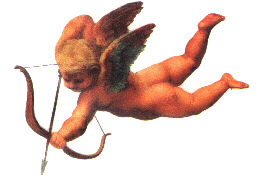
mass-produce valentines. And let's not forget Cupid, the second
most popular symbol of Valentine's Day. The son of Venus, the Roman
goddess of love and beauty, Cupid shot his bittersweet arrows at
humans, gods and goddesses alike, causing them to fall deeply in
love. How much more Pagan can you get?





